Multi-agent orchestration in Blazorly
Swarms, reviewers, and teams run as children of the chat you already have. The sidebar does not become a second product.
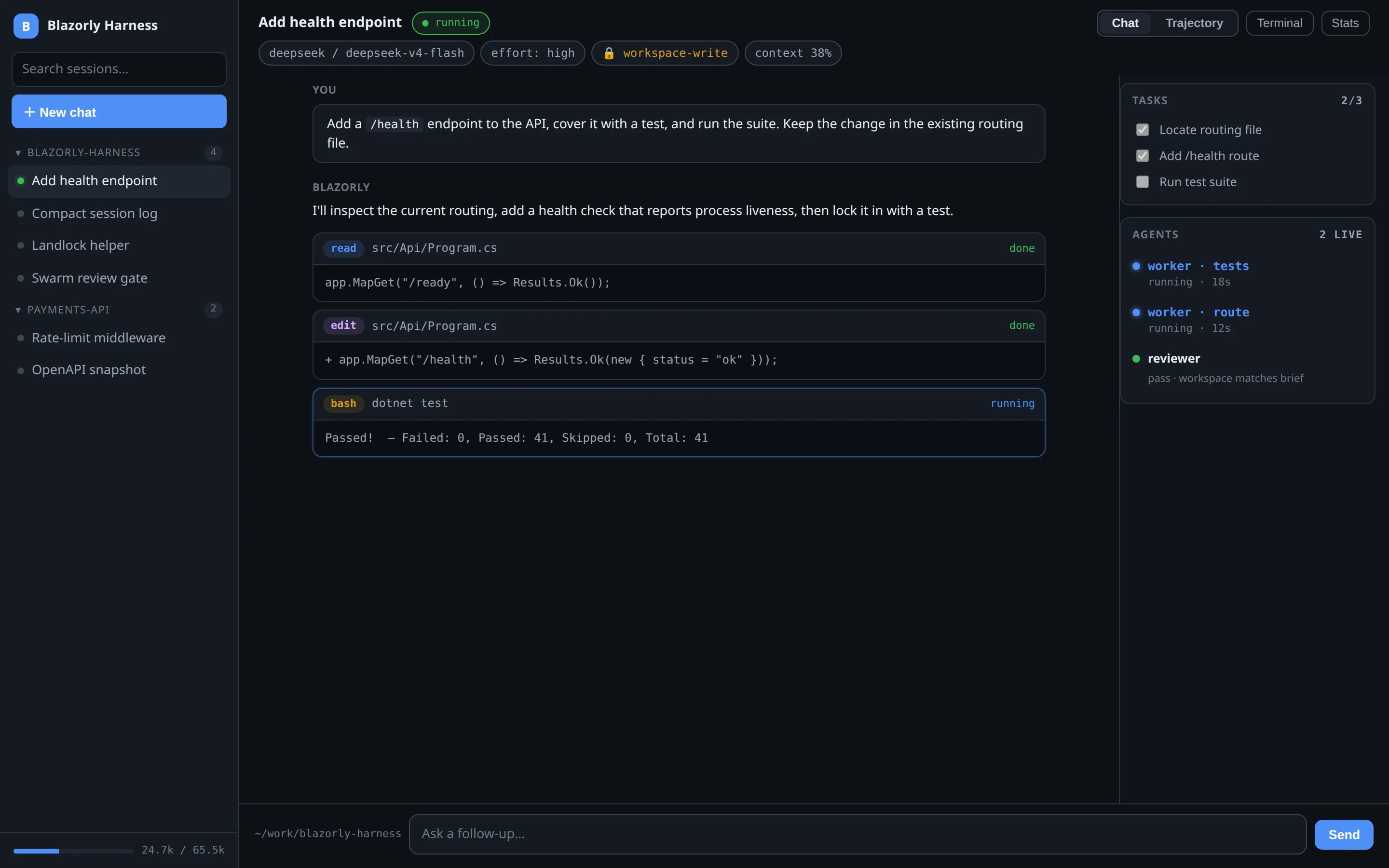
Blazorly’s multi-agent features spawn sub-agents that each have their own session, provider, and workspace, but they render inside the parent conversation. The Agents panel — beside the task list — shows live status per worker: pulsing while running, a check when done, a link to the child session. The system prompt keeps delegation for large or parallel work; a single file edit stays with the lead. A delegated child never blocks on you: ask_user_question answers itself.
swarm
A planner shards the objective. Workers run in parallel. A reviewer inspects the actual workspace, not the workers’ claims. Failed tasks re-dispatch with the review notes attached. Use this when the work splits cleanly — “implement the route, write the test, update the OpenAPI file” — and you want a gate at the end that looks at git status and the test run, not at a summary.
review
An independent agent forks from the current conversation, reads the files, runs tests, and returns a structured verdict: pass, fail, or concerns. That is a different job from the lead, on purpose. The lead has just written the code; the reviewer is scored on whether the workspace matches the brief.
Teams
When enabled (enableTeams), the lead can spawn_teammate, send_message, and use a shared task board. Batch sends run teammates in parallel. This is the longer-lived variant of a swarm: people-shaped roles instead of a one-shot fan-out.
Background sub-agents
subagent_start, subagent_send, subagent_list, subagent_interrupt. Fire work, keep chatting, poll later. Settled children cold-resume days later because their sessions are durable logs, not in-memory tasks. Interrupt is a first-class call, not “hope the child notices.”
What we refuse to do
- Open a new sidebar row for every worker. Inspection is a click from the Agents panel.
- Let a child sit on a multiple-choice prompt aimed at you. That is how fan-out deadlocks.
- Delegate a rename or a one-line lookup. The lead should just do it.